
FERAZ AZHAR | University of Notre Dame
Flows into de Sitter space from anisotropic initial conditions: An effective field theory approach (with David I. Kaiser)
For decades, physicists have analyzed various versions of a “cosmic no-hair” conjecture, to understand under what conditions a spacetime that is initially spatially anisotropic and/or inhomogeneous will flow into an isotropic and homogeneous state. Wald’s theorem, in particular, established that certain homogeneous but anisotropic spacetimes, if filled with a positive cosmological constant plus additional matter sources that satisfy specific energy conditions, will necessarily flow toward an (isotropic) de Sitter state at late times. In this talk, using an EFT-based dynamical framework, I’ll describe recent work on the flow of homogeneous but anisotropic spacetimes toward (isotropic) de Sitter states under conditions more general than those to which Wald’s theorem applies. In particular, in the absence of a bare cosmological constant, and for effective matter sources that do not obey the energy conditions required for Wald’s theorem, the evolution of homogeneous but anisotropic spacetimes can be consistent with the emergence of an effective cosmological constant.

JAMEE ELDER | Tufts University
How Theory-laden are Observations of Black Holes? (with Juliusz Doboszewski)
We assess simulations relying on general relativistic assumptions in the context of the roles they play in some of the recent observations of black holes. This includes numerical relativity simulations in the case of LIGO-Virgo and general relativistic magnetohydrodynamic simulations in the case of the Event Horizon Telescope. We argue that in both experiments simulations play an “ampliative” role. This comes at a cost of theory ladenness; we argue that it leads to a problematic circularity in the former case, but not in the latter, and classify some of the strategies used to remedy the circularity.

SEAN GRYB | University of Groningen
The Shape of Past and Future (with David Sloan)
Determining the origins of the arrow of time in our universe is a stubbornly difficult task. There are many different formulations of the problem and approaches to solving it, some of which are popular but none of which are completely satisfactory — at least not to everyone involved. In this talk, I will propose a new kind of approach whose primary insight is that removing the overall scale of the universe shatters our intuitions for what kinds of states are typical in the past and future. First, I will argue that it is epistemologically sound and methodologically advisable to remove the overall scale from our representations of the universe. Then I will focus on two empirical puzzles that I think are central to the origins of the arrow of time: why was the early state of the universe so smooth and why was there so much red-shift? I will show that removing scale leads to a picture with highly clustered attractors in the future and smooth looking, violently red-shifting states in the past. Observers like us can then learn to tell past from future by seeing through the Emperor’s new clothes at the shapes that lie beneath.

ABIGAIL HOLMES | University of Notre Dame
Are there independent measurements of the Hubble constant?
The Hubble tension is an ongoing debate in astronomy and cosmology over the value of the Hubble constant, H0, a measurement of the present expansion of the Universe. Planck (2018) determined that H0= 67.4±0.5 km/s/Mpc by fitting a range of cosmological parameters to observations of the cosmic microwave background. Riess et al. (2022) determined that H0= 73.04±1.04 km/s/Mpc, using the distance and redshift of distant supernovae. These values differ at the 5-sigma level, which is significant enough to motivate serious debate about the need to revise the LCDM cosmological paradigm. Alternative measurements of H0 have proliferated: the inverse distance ladder, baryon acoustic oscillations, the tip of the red-giant branch distance ladder, quasar lensing, and more. There are now several methods that agree with the lower H0 value, and several that agree with the higher value. This has strengthened the call for new physics through consilience arguments; if multiple independent methods agree on both values, then both values are considered accurate. I will examine the strength and epistemic significance of these consilience arguments. First, the strength of the argument relies on the independence of the methods in question, but the meaning of ‘independence’ is often left undefined in the literature. I have identified a range of features according to which these methods are claimed to be independent. Whether two methods are independent on this scheme is highly theory dependent. Therefore, these methods are at best quasi-independent. Finally, what is the epistemic significance of these consilience arguments; should they motivate us to accept that we have measured true values of H0? I will argue that they do not, given the previously argued theory dependence of the independence of the measurement methods. This is not a skeptical worry about a mysterious future theory undermining the independence but is instead rooted in both realistic current science.
KATHERINE MACK | Perimeter Institute for Theoretical Physics
Dark Matter: A Cosmological Perspective
While it is considered to be one of the most promising hints of new physics beyond the Standard Model, dark matter is as-yet known only through its gravitational influence on astronomical and cosmological observables. I will discuss our current best evidence for dark matter’s existence as well as the constraints that astrophysical probes can place on its properties, while highlighting some tantalizing anomalies that could indicate non-gravitational dark matter interactions. Future observations, along with synergies between astrophysical and experimental searches, have the potential to illuminate dark matter’s fundamental nature and its influence on the evolution of matter in the cosmos from the first stars and galaxies to today.

LUCA MARCHETTI | University of New Brunswick
Cosmic Emergence in Quantum Gravity (NB: this video is in two parts.)
It is a general expectation in several approaches to quantum gravity that continuum (in particular cosmological) physics emerges as a macroscopic phenomenon from the collective behavior of fundamental quantum gravity degrees of freedom. However, a physical understanding of this cosmic emergence process requires us to address deeply intertwined technical and conceptual issues. In this talk, I will focus on two of them: the localization problem, related to the background independence of the underlying quantum gravity theory, and the coarse-graining problem, related to the extraction of the macroscopic, continuum physics from the microscopic, quantum gravitational one. After discussing what strategies can be adopted in general to address these issues, I will show a concrete implementation of such strategies in the context of the group field theory approach to quantum gravity, and outline the main properties of the resulting emergent cosmological physics.

DOMINIC RYDER | London School of Economics
The Idealization Paradox in Hawking Radiation
I argue that three mainstream derivations of Hawking radiation all contain an unresolved paradox. These are Hawking’s original derivation (1975), Fredenhagen and Haag’s mathematically “watertight” derivation (1990), and the algebraic approach (Dimock and Kay, 1987). The paradox is due to the fact that the derivations are carried out in a spacetime which does not model black hole evaporation whereas, given the existence of Hawking radiation, black holes are expected to evaporate. Therefore, one should be able to deidealize the derivations and carry them out on spacetimes which model black hole evaporation. However, assumptions essential for the derivations breakdown in evaporation spacetimes, and so it appears the idealization of non-evaporation is essential for these derivations. In this talk I present and defend the existence of the idealization paradox by showing that for all three approaches, assumptions necessary for them to be carried out breakdown in evaporation spacetimes. I then canvas possible resolutions to the idealization paradox and argue that, given a resolution, we may learn about: the operation of idealizations in physics, how global structure encodes local structure in general relativity, the nature of Hawking radiation, and how science uses models to make progress.
MIKE SCHNEIDER | University of Missouri
First, what is quantum cosmology? Inspired by remarks by Vidotto (2017), I observe that there is no other satisfying answer than this: quantum cosmology is an application of quantum gravity to large-scale cosmic structure, relative to small observers (in momentum space) who passively count time. Second, what is the emergence of classical cosmology — i.e. relativistic, approximately uniform Euclidean space, approximately expanding according to the Friedmann equations — from this perspective on quantum cosmology? I argue that it is a quantum gravity phenomenon, as is the emergence of a classical isolated black hole (albeit relative to a different kind of observer passively counting time: an asymptotically distantly situated observer, rather than a small observer in momentum space). It follows from the second argument that: (1) quantum gravity phenomena can be as big as we can conceive; (2) possible UV/IR mixing in quantum gravity does not “put the classical cosmos in a box”; and (3) quantum gravity phenomena are more than just emergent dynamics and initial conditions. (1) is a clarification and partial defense of a recent line of argument I have advanced elsewhere, that quantum gravity phenomenology be considered in terms of radically free researchers choosing to co-create with nature quantum gravity phenomena. (2) is an argument against the attractiveness of certain forms of holographic dark energy proposals, as well as a plea for more careful thinking about what indication of some possibly inevitable fact about UV/IR mixing in quantum gravity means for phenomenology. (3) is an elaboration of another recent line of argument I have been pursuing, concerning failures of effective field theoretic or “exit from spacetime foam” thinking about spacetime emergence at the Planck or species scale. Both (2) and (3) are conclusions concerning emergent global spacetime structure relative to small observers (in some or other sense). (1), or, rather, the larger thesis supported by it, helps to situate those conclusions in a viable foundations for effective, empirical research on the problem of quantum gravity. Altogether, (1-3) shed greater light on how classical cosmology can be leveraged to help “close the loop” (Smith 2014) in effective, empirical research conducted within a quantum gravitational world.
CHRIS SMEENK and ADAM KOBERINSKI | University of Western Ontario
Do We Have a Theory of the Early Universe?
LEE SMOLIN | Perimeter Institute for Theoretical Physics
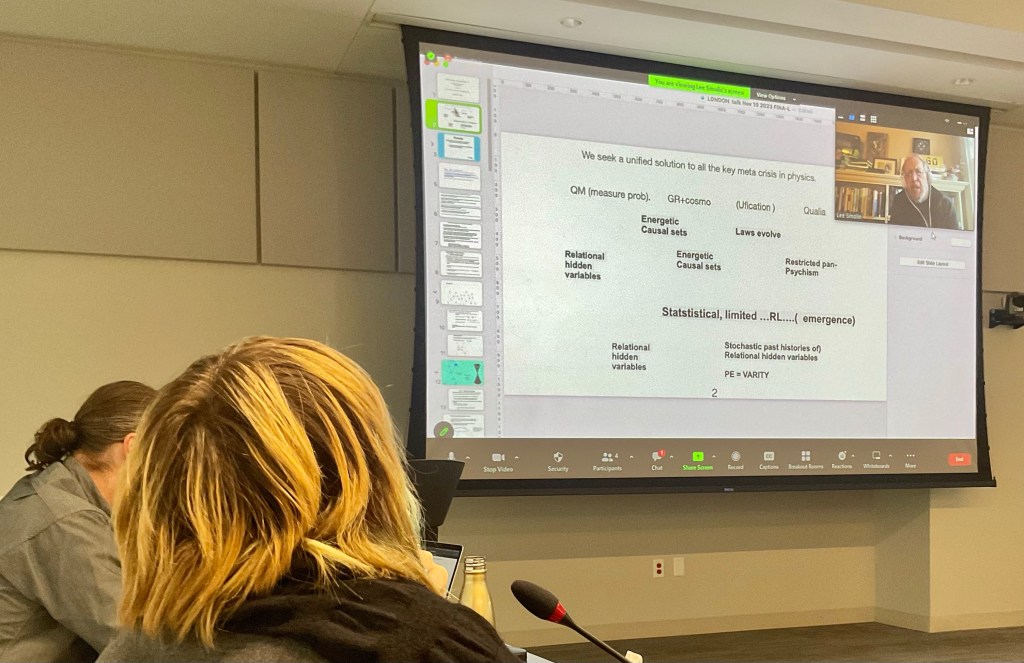
 Beyond Spacetime