Live blogging: Harvey

First example of (Duality=Gauge) is the T-duality exhibited by string theory on a circle. R gets send to ~1/R.

At the fixed point of this transformation, the theory exhibits an SU(2) gauge symmetry and the T-duality transformation is a discrete transformation in SU(2). It is a redundancy at that point, hence at all points.

Second example: in N=4 SYM, the duality comes from large diffeomorphisms of a torus.

Live blogging: Harvey

The duality era:

This started with an idea of Ashok Sen’s i.e. that N=4 Super-Yang-Mills has a weak-strong coupling, electric-magnetic duality. I.e., parameters have the symmetry SL(2,C).

Harvey shows picture of how values of parameters that label different theories lie in the fundamental region of SL(2,C). Can always map strong coupling to weak coupling.

This was quickly extended to SUSY string theories and led to results about Calabi-Yau spaces. Harvey thinks that the dualities should be understood as different descriptions of one underlying object.

Quotes Rickles as drawing an analogy between dualities and gauge symmetries. Harvey adds that there are examples where dualities really are the same as gauge symmetries (Duality=Gauge).


Live blogging: Harvey

Those people were mostly ignored.

In 1984, the discovery of anomaly cancellation, heterotic string, and Calabi-Yau compactification led to a cartoon version of the Standard Model. Initially very few Calabi-Yau manifolds were known, but mathematicians eventually found thousands…

Does this make string theory untestable? Harvey thinks this is too strong a statement, but that it does make test more difficult. It is also hard to know which gauge groups and representations to use for the gauge theories underlying the Standard Model. Harvey says that the fundamental problem with testing string theory is the energy scale we have access to.

Audience: are you thinking of string theory as a framework and not as a theory? E.g. like gauge field theory

Harvey: Yes, that’s a reasonable point of view. Yes that’s what I’m proposing.
Live blogging: Harvey

Harvey will focus on later stages. 

Origins of string theory were to explain strong interactions, i.e. hadronic resonances and Regge behavior of scattering at high energies and fixed angles. This approach floundered because mathematical consistency required 26 or 10 dimensions, and because no mechanism was found to remove the massless spin 1 and spin2 states that didn’t match the hadronic resonances.

In 1974, Scherk, Schwarz and Yoneya proposed a reinterpretation. Massless spin 2 particles was graviton, massless spin one particles are gauge fields, and string theory was a method to unify gravity with gauge theory in a relativistic framework.

Live blogging: Harvey

Title: Where is string theory today?

Hard to talk about where we are today without saying where we’ve been. Different eras of string theory: 

1968-74: Dual resonance era, ended with discovery of asymptotic freedom

1975-83: Quantum gravity Era, people pushing this idea were mostly ignored

1984-94: Unification Era, emphasis on CFT techniques

1995-1998: Duality Era, emphasis on spacetime point of view, and role of SUSY

Finally, we might be at the end of AdS/CFT era.

Live blogging: Vidotto

Now Vidotto describes some of the dynamics of spinfoam amplitudes, and claims that some beautiful work (Barrett, Dowall, Fairbain, Gomes, Hellmann, Alesci…’09) has shown that in the semi-classical limit, one can get some nice classical structures to fall out of the dynamics, e.g. FRW-like geometry.

Conclusion:  Atomism is fundamental, and so is relationalism.  To exist is to interact, to stand in relations.  Fundamentally what exists are processes;  spacetime itself is a process.

Live blogging: Vidotto

The reconciliation: LQG gives us a spacetime that is both relationalist and substantial. Spacetime is made up of spacetime quanta and their relations with their neighbors.  (Blogger notes: this makes it congenial to Decartes’ relational view of extension!)

Now Vidotto heads into a more technical phase of her presentation, putting up some of the apparatus of the LQG approach, but the point is to argue that geometry (e.g. distance) emerges naturally from the structures, with no need to presuppose any background manifold.

Live blogging: Vidotto

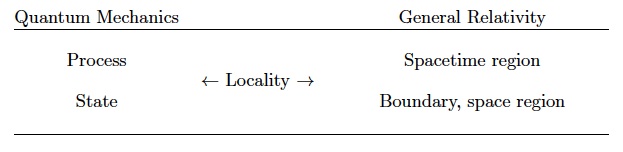
Vidotto argues that both QM and GR are relational in an important sense.  In both theories, understood properly, everything observable and measurable amounts to the relationship between one system and another.

In GR and QG, this leads to a kind of locality: all interactions are between contiguous systems.

Audience: how does this square with EPR non-locality?  Vidotto: Relational QM resolves the EPR ‘paradox’ by allowing a way of understanding what’s going on without anything non-local happening.

Quantum mechanics + gravity (GR) entails minimum length in nature; as Bronstein argued in 1933, the fact that finer and finer localization requires higher and higher energy, and energy gravitates in GR, puts a limit on how finely localized something can be without the energy of localization being such as to hide the localized system inside its own Schwarzschild limit.