Dean Rickles gave his talk, “Dual Theories: ‘Same but different’ or ‘Different but Same’?” in April at UIC. The video for the talk is now available to view, and also accessible on the Speaker’s Page.
Henrique Gomes’ talk now available!
Gomes is one of the winners of our essay prize this year and gave a talk on May 25, 2016 at UIC. The video of his presentation is now available to view, and also accessible on the Speaker’s page.
Big News – Summer School Video!
We are really happy to announce that (almost) all the video of lectures from the recent Summer Institute are now available online, click above or go here:
https://beyondspacetime.net/summer-institute-program/
(or to our YouTube site). We have included the schedule, so if you like you can follow the same course of lectures that we did. Or you can choose á la carte.
Lectures from: Wüthrich, Ismael, Rovelli, Belot, Ney, Minic, and Matsubara, and (soon) more. Enjoy, and please tell your friends!
Visitor Program – small grants
This is a reminder that we have a program that offers small grants (up to $600) for visits of a few days or weeks to either Geneva or UIC, for scholars working in relevant fields. Please come and join in! Details are above, or here.
Images of the summer school
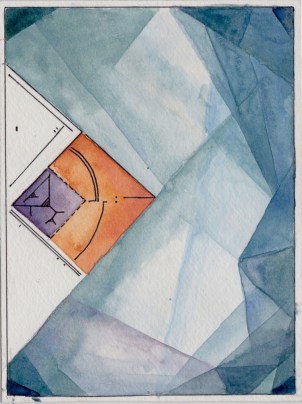
One of the participants of the summer school, the amazing Kaća Bradonjić, painted wonderful watercolours of the talks and discussions, which you can find here:
http://kacabradonjic.com/projections/
Here’s one as a taster – “Space and Time (or not) in Loop Quantum Gravity” (inspired by a talk by Carlo Rovelli).
Summer Institute
We just wanted to say thank you to everyone at the summer institute in Williams Bay this past week – it was a great success thanks to the efforts of all concerned. We will post some photos soon!
Reply to Read
Sebastian De Haro has written a response to James Read’s talk on background independence – and Read has written a reply to it. If you watch the talk, they are recommended reading: the two of them have discussed the matter at length, and are actively pursuing the discussion. Find the paper here:
Click to access de-haro-read.pdf
or linked on YouTube to the video itself.
Summer Institute Updates
The schedules of lectures, and of discussion groups are now up on the website (follow the links above)! Sorry for those of you we couldn’t have along: we will be videoing the lectures for later publication – so you will be able to take the school virtually later in the summer. (Sorry, no livestream.) Watch this space for news.
2017 Essay Prize Competition
We are happy to announce our second Essay Prize Competition! Up to three prizes of $1000 will be awarded for papers on any topic concerning the philosophical foundations of quantum gravity. We are particularly (but not exclusively) interested in work that addresses the foci of the ‘Space and Time After Quantum Gravity’ project: Does quantum gravity eliminate spacetime as fundamental structure? How does quantum gravity explain the appearance of spacetime? What are the broader implications of quantum gravity or of the emergence of spacetime for metaphysical (and other) accounts of the world?
Please see more details here: https://beyondspacetime.net/essay-prize-2017-cfp/
Talks this week!
This Friday June 17th 2016 at UIC at 3pm we have a double header from our two Geneva predoctoral fellows – please join us.
NOTE THE NON-STANDARD TIME
Radin Dardashti (Munich Center for Mathematical Philosophy, and Geneva): Testing Theories, Theory Space and Scientific Practice
Abstract: “Many scientific theories in fundamental physics are lacking empirical support. While in some cases future experiments may allow empirical testing (supersymmetry), this is less obvious in other cases (theories of quantum gravity, cosmic inflation). One possible way of addressing this problem is to analyse whether empirical evidence provides the only means to confirm our theories. In this talk I will present a generalised perspective on theory confirmation, which relies on the concept of theory space. This allows us to extend the notion of theory confirmation to evidence, which is not necessarily made more or less likely by the theory itself. I will discuss the advantages of this more general perspective on scientific theory assessment, discuss some examples and what their normative implications are for the practicing scientist.” In terms of technical difficulty, this talk rates 2/5 
Juliusz Doboszewski (Jagiellonian University, and Geneva): Is anti-de Sitter spacetime physically reasonable?
Abstract: “Solutions of classical general relativity are often divided into physically reasonable and physically unreasonable ones. For example, physically reasonable spacetimes are sometimes expected to satisfy some energy condition, be globally hyperbolic, inextendible, hole free, or stable against perturbations. I will discuss (a) how conditions used to draw such a divide apply to anti-de Sitter spacetime, and (b) how violation of some of them should be interpreted in the context of gauge/gravity duality.” In terms of technical difficulty, this talk rates 4/5 

